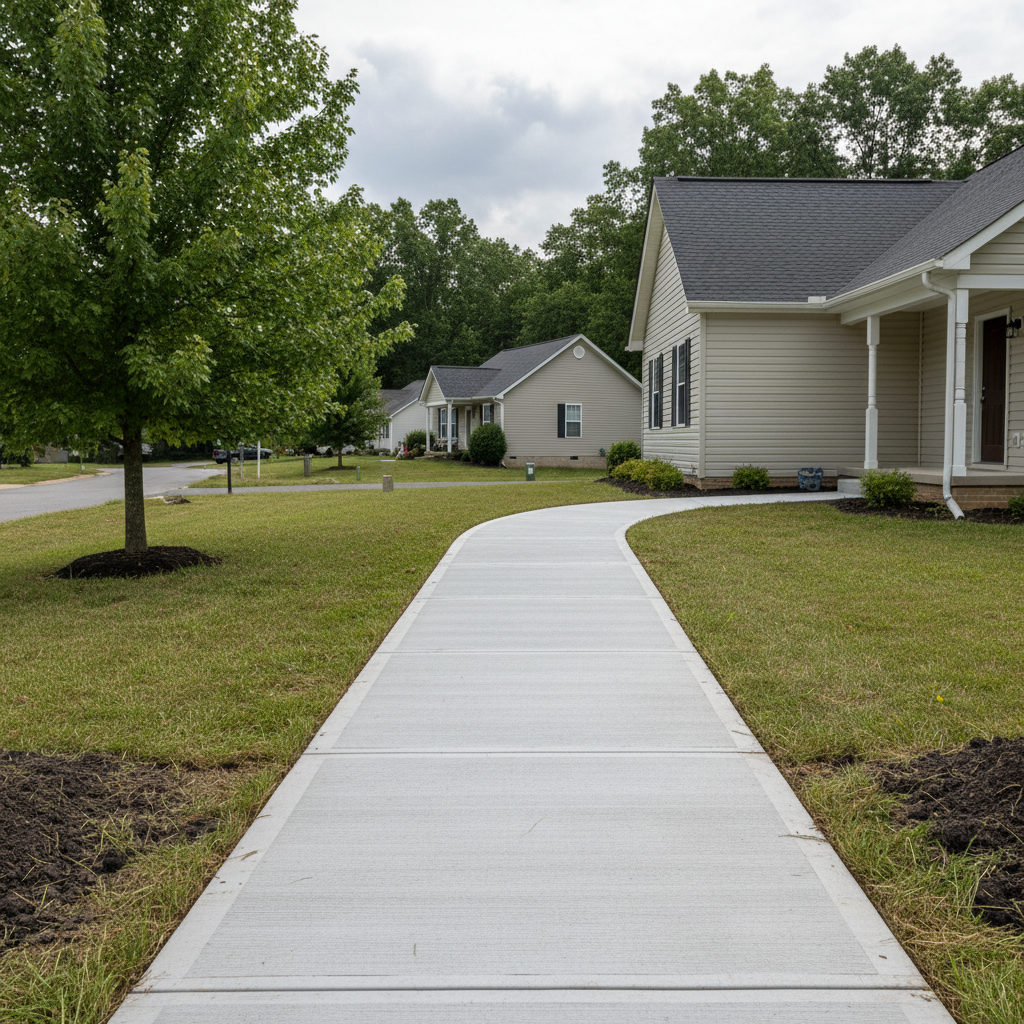
So, you're thinking about putting in a new concrete sidewalk, or maybe swapping out a cracked old one, right here in Waldorf. Smart move. A good, solid sidewalk doesn't just look nice; it's also a safety thing. Nobody wants a tripping hazard on their property, do they? But let's be honest, you're probably wondering what this whole project is going to cost. It's not a simple "X dollars per foot" kind of deal, but I can certainly give you a decent idea of what to expect.
What Makes the Price Go Up or Down?
A few big factors really sway the cost when you're talking about concrete sidewalks. It's more than just the concrete itself, believe it or not.
- Size and Shape: This one's pretty obvious, isn't it? A longer, wider sidewalk needs more material and more hours from the crew. But also, if it's got a lot of curves or tricky angles, that takes more time and skill to form up than a straight path.
- Site Prep: This can be a huge factor. If we're just pouring on flat, untouched ground, that's one thing. But if we have to rip out an old sidewalk, dig up roots, or level out a sloped area, well, that's extra work and extra cost. Here in Waldorf, especially in some of those older neighborhoods like St. Charles, you often run into tree roots that have just destroyed old sidewalks, or ground that's settled unevenly over the years. That kind of demolition and grading really adds up.
- Concrete Thickness and Mix: Most sidewalks for homes are 4 inches thick. That's usually plenty for people walking on it. But if you're planning on driving a car or truck over it, even just sometimes, you'll need 6 inches and a stronger concrete mix, which costs more.
- Reinforcement: Standard sidewalks usually get rebar or wire mesh to help keep them from cracking. If you need something tougher, like fiber mesh or more extensive rebar, that's another expense.
- Finish: A basic broom finish is the most common and the cheapest option. If you want something decorative like stamped concrete, exposed aggregate, or a colored finish, you're looking at a pretty big jump in price. Why? Because it's more labor-intensive and needs specialized materials and techniques.
- Accessibility Needs: If you need ramps or specific slopes to meet ADA rules, that means more complex forming and pouring.
Typical Cost Ranges in Waldorf
Alright, let's get to some actual numbers. For a standard 4-inch thick concrete sidewalk with a broom finish, you're generally looking at anywhere from $10 to $18 per square foot. That's a pretty wide range, I know, but it truly depends on those factors I just mentioned.
Let's break it down a bit more:
- A small, straightforward 100 sq ft sidewalk (like a short path to your front door) might be on the higher end of that per-square-foot range, maybe $15-$18/sq ft. That's because there are fixed costs involved no matter the size. So, expect something like $1,500 - $1,800.
- A medium-sized 300 sq ft sidewalk (maybe running along the front of your house) could be more like $12-$15/sq ft. That's $3,600 - $4,500.
- For a larger project, say 500 sq ft or more, you might see prices closer to the $10-$12/sq ft range. So, $5,000 - $6,000.
Now, if you want a decorative finish, like stamping or exposed aggregate, you can easily add another $5 to $15 per square foot on top of those base prices. So, a stamped sidewalk could easily run you $20-$30+ per square foot.
What Should Be in Your Quote?
When you get a quote from a contractor, make sure it's really detailed. You definitely don't want any surprises later. Here's what I always include when Oasis Concrete gives you a price:
- Square footage: The exact size of the planned sidewalk.
- Thickness: 4 inches, 6 inches, you get the idea.
- Concrete mix strength: Usually specified in PSI (pounds per square inch).
- Reinforcement: Wire mesh, rebar, fiber mesh – whatever they're using.
- Site preparation: This should spell out excavation, grading, and getting rid of any old concrete or debris.
- Base material: What kind of gravel or aggregate will go under the concrete, and how thick it will be.
- Finish type: Broom, stamped, exposed aggregate, etc.
- Expansion and control joints: Where they'll be placed. These are super important for stopping random cracks.
- Cleanup: What they'll do to leave your property tidy when they're done.
- Permits: Who's responsible for pulling any necessary permits (usually the contractor handles this).
How to Avoid Overpaying
First off, get several quotes. Three is a good number to aim for. But don't just pick the cheapest one, okay? A super low bid can be a big red flag for cutting corners. Ask questions about anything that's unclear in their proposal.
Make sure the contractor is licensed and insured. Seriously, don't skip this step. If something goes wrong, you want them to be covered, not you. Check references and look at their past work. You can tell a lot about a contractor by the quality of their previous jobs, after all.
Be clear about what you want right from the start. Changing your mind halfway through the project is almost always going to cost you more money and cause delays. Understand the full scope of work and make sure it's all in writing before any work begins.
A good concrete sidewalk is an investment that'll last for decades. Do your homework, ask the right questions, and you'll end up with a solid path you can truly be proud of.